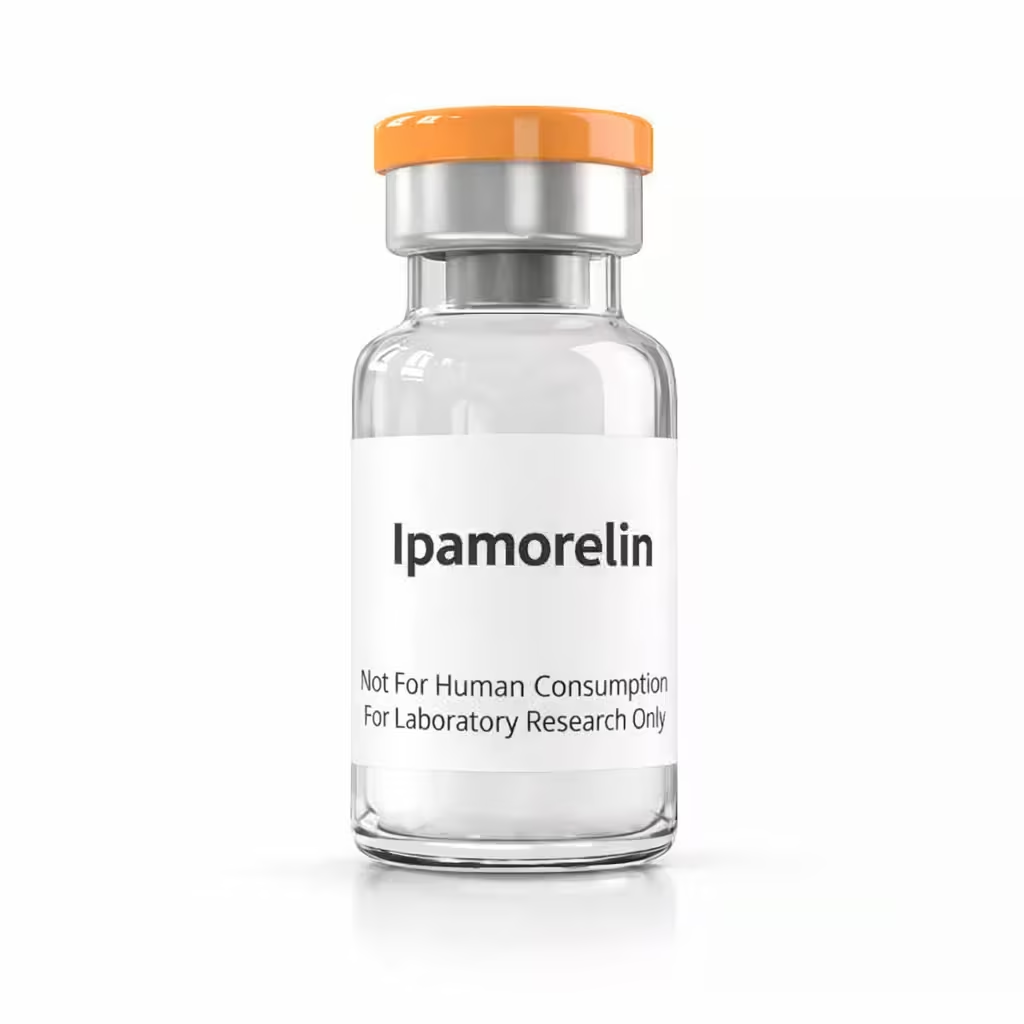
Selective GHSR Agonist | Per Vial
From $35.00 / vial
4.9 / 5.0 - 341 reviews
Select Products
The cleanest GH secretagogue: stimulates growth hormone release without raising cortisol, prolactin, or acetylcholine - ideal for long-term anti-aging and body recomposition protocols
Ipamorelin is a synthetic pentapeptide and selective growth hormone secretagogue receptor (GHSR) agonist. Its key advantage over earlier GHRPs like GHRP-2 and GHRP-6 is its exquisite selectivity: it stimulates GH release potently while producing no meaningful increase in cortisol, prolactin, or ACTH at standard doses. This clean hormonal profile makes Ipamorelin the preferred secretagogue for long-term use in anti-aging, body composition, and sleep quality protocols. It is frequently stacked with CJC-1295 No DAC to synergistically amplify GH output.
Also see: CJC-1295 common stack | Official info: PubMed Ipamorelin Research
When GHRP-2 and GHRP-6 were introduced, they represented a breakthrough in GH stimulation. However, both produce significant side effects at effective doses - particularly cortisol and prolactin elevation from GHRP-2, and pronounced hunger from GHRP-6 due to ghrelin receptor stimulation. Ipamorelin addressed these limitations by introducing a highly selective GHSR agonist that stimulates GH release potently without meaningfully affecting cortisol, prolactin, or ACTH at standard doses. This selectivity makes it uniquely suitable for long-term wellness protocols where hormonal side effects must be minimized.
Clinical and research data consistently show Ipamorelin produces dose-dependent GH release with a safety and selectivity profile superior to earlier GHRPs. Its combination with CJC-1295 No DAC is the most widely used GH peptide stack in clinical anti-aging and performance medicine today.
| Peptide Name | Ipamorelin |
| Sequence | Aib-His-D-2-Nal-D-Phe-Lys-NH2 |
| Molecular Weight | 711.9 g/mol |
| Half-Life | ~2 hours |
| Form | Lyophilized powder for reconstitution |
| Purity | > 99% (HPLC verified) |
| Storage | Refrigerate at 2-8C; avoid light |
| Price | From $35.00 per vial |
Sleep depth and recovery quality are typically the first improvements noted. Reduced muscle soreness following training and improved energy on waking reflect early IGF-1 upregulation and enhanced nocturnal GH release.
Body composition changes become measurable. Users typically observe improved lean mass-to-fat ratio, improved skin texture, and enhanced exercise performance and endurance reflecting cumulative IGF-1-mediated tissue effects.
Full protocol benefits: sustained lean body composition, improved connective tissue density, enhanced cognitive function, and consistent energy levels. Effects persist weeks to months beyond cycle completion.
Ipamorelin is administered subcutaneously 1-3 times daily, with the most important dose timed 15-30 minutes before sleep. Fasting or low insulin levels at the time of dosing optimize GH pulse magnitude by removing insulin's inhibitory effect on GH secretion. Reconstituted with bacteriostatic water, it remains stable for approximately 28 days under refrigeration.
Ipamorelin binds selectively to the growth hormone secretagogue receptor (GHSR-1a) on pituitary somatotrophs. Unlike GHRP-2, it has no significant affinity for non-GH receptors, which explains its clean side effect profile. GHSR-1a activation triggers a phospholipase C-dependent signaling cascade that results in intracellular calcium release and GH secretory granule exocytosis.
The GH pulse produced by Ipamorelin is clean and selective - no cortisol surge, no prolactin elevation, minimal ACTH activation at research doses. This selectivity is critical for long-term use because it means the protocol can be sustained without the hormonal disruption associated with broader-spectrum GHRPs. The GH pulse produced by Ipamorelin peaks approximately 60-90 minutes post-injection.
The GH pulse triggers hepatic IGF-1 synthesis, which mediates Ipamorelin's primary benefits: lean tissue anabolism, fat mobilization, collagen synthesis in skin and connective tissue, and enhanced cellular repair. Combined with CJC-1295 No DAC's GHRH stimulation, the resulting IGF-1 elevation from a CJC/Ipamorelin stack can be substantially greater than Ipamorelin alone.
Ipamorelin is ideal for adults seeking to optimize growth hormone output safely and sustainably without the side effects of less selective GHRPs. Its clean profile makes it suitable for long-term use in anti-aging protocols, and its body recomposition effects make it popular among athletes and active adults. It is particularly well-suited for individuals who have tried earlier GHRPs and found the cortisol, prolactin, or hunger side effects problematic.
Consult a licensed healthcare provider before beginning any peptide protocol. See Important Safety Information below.
GHRP-2 and GHRP-6 both stimulate GH release effectively but activate other receptor pathways as well. GHRP-2 elevates cortisol and prolactin, which can be counterproductive for wellness and body composition goals. GHRP-6 causes pronounced hunger via ghrelin receptor activation. Ipamorelin is selective for GHSR-1a and does not significantly activate these other pathways at research doses, making it a cleaner, more sustainable choice for long-term GH optimization protocols.
Ipamorelin is effective as a standalone peptide, producing meaningful GH pulses when used alone. However, it produces significantly greater GH output when stacked with a GHRH analog like CJC-1295 No DAC. The GHRH signal from CJC-1295 primes somatotrophs and amplifies the Ipamorelin-triggered pulse synergistically. For maximizing body composition and anti-aging benefits, the combined stack is generally recommended in the research literature.
Mild, transient water retention can occur with Ipamorelin use, particularly in the early weeks of a protocol, as elevated IGF-1 can increase sodium and water retention. This typically subsides after 2-4 weeks as the body adapts. It is generally mild compared to what is observed with synthetic HGH at equivalent IGF-1 elevation levels. Staying well hydrated and minimizing sodium intake can help manage this effect during the initial adaptation period.
Most protocols run for 3-6 months, followed by a rest period. Unlike synthetic HGH, Ipamorelin works with the body's natural GH axis rather than suppressing it, so extended protocols are generally considered lower risk. Because receptor desensitization with Ipamorelin is minimal, many practitioners run longer cycles than with less selective GHRPs. Body composition and sleep improvements often persist for several months after a completed cycle.
Important Safety Information